Awards and Supports 2026
- Three EPS-QEOD Travel Grant Student Awards were distributed during Nanometa 2026.
Laureates: Oral talk #43
Amit Kam, Physics department, Technion – Israel Institute of Technology, Haifa, Isreal
Entanglement of Near-Field Photons in Their Total Angular Momentum
Poster #105
Baurzhan Salimzhanov, University of Southampton, UK, Chiral Time Crystal – Modelling the Matter-to-Life Transition
Oral talk #38
Florian Mangold, University of Stuttgart, Germany
Discovery of phonon-polaritonic skyrmions: Transition from bubble- to Néel-type

Please review the eligibility requirements for the EPS-QEOD Travel Grant Student Awards and EPS Individual Member (IM) Travel Grants.
A series of prizes and awards were formally presented at the Closing Ceremony of Nanometa 2026 in January 2026:
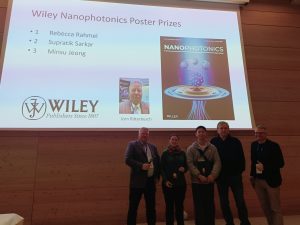
- Nanophotonics Student Poster Prizes – A poster competition, sponsored by Nanophotonics, was organised to recognise three best posters presented by research students.
Nanophotonics (Wiley) publishes cutting-edge research on the interaction of photons with nanostructures,
including carbon nanotubes, metal nanoparticles, semiconductor nanodots, photonic crystals, metamaterials,
tissue, and DNA. We highlight global advances, emerging developments, and novel applications in the field. All
articles in the journal are freely available under gold open access, ensuring broad visibility and accessibility for
the international photonics community.

Laureates:
Poster #98
Rebecca Rahmel, Institute of Physics (IA), RWTH Aachen University, Aachen
Optical resonance tuning of single polystyrene microspheres using the phase-change material In3SbTe2 as a switchable mirror
Poster #59
Supratik Sarkar, University of Maryland, College Park, USA
Multi-timescale Frequency–Phase Matching for High-Yield Nonlinear Photonics
Poster #47
Minsu Jeong, Pohang University of Science and Technology, South Korea
Symmetry breaking in the honeycomb lattice for the chiral resonance
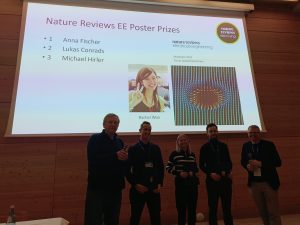
- Nature Reviews Electrical Engineering – A poster competition, sponsored by Nature Reviews Electrical Engineering, was organised to recognise three best posters presented by research students.
Nature Reviews Electrical Engineering is an online-only journal offering authoritative Reviews, Perspectives, and Comments across the breadth of electrical engineering, including electronics, photonics, power and energy systems, control, signal processing, and telecommunications. It provides insight for researchers, engineers, industry professionals, and non-specialists, covering topics such as electronic devices, optoelectronics, renewable energy, wireless communications, and robotics. Beyond technical advances, the journal addresses societal, ethical, environmental, and commercial dimensions of the field, fostering dialogue on how engineering solutions can tackle global challenges. For submission details, contact the Chief Editor, Rachel Won, at NRElectrEng@nature.com and r.won@nature.com.

Laureates:
Poster # 93
Anna Fischer, IBM Research Europe, Rüschlikon, Switzerland
Time-domain photonic convolutional accelerator
Poster #108
Lukas Conrads, RWTH Aachen University, Aachen, Germany
Infrared beam-shaping on-demand employing optically programmed metasurfaces with the phase-change material In3SbTe2
Poster #150
Michael Hirler, Ludwig-Maximilians-Universität, Faculty of Physics, Munich, Germany
Accessible, All-Polymer Metasurfaces: Low Effort, High Q
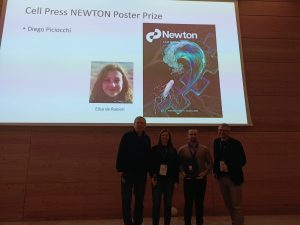
Newton Student Poster Prize – A poster competition, sponsored by Newton Cell Press, was organised to recognise the best poster presented by research students.
Newton is the flagship physics journal from Cell Press. Launched in 2025, Newton publishes the most
influential research across all areas of fundamental and applied physics, and interdisciplinary
fields. Newton serves and connects the global physics community by showcasing breakthrough results through
transparent, high-quality, and inclusive peer review and editorial processes.

Laureate:
Poster #100
Diego Piciocchi, Institute for Quantum Electronics and Quantum Center, ETH Zürich, Switzerland
Localisation Transitions by Temporal Disorder in Liquid Light
Awards and Supports 2024
Three EPS-QEOD Travel Grant Student Awards were distributed during Nanometa 2024.
Laureates:
Poster #4
Jonas Herbig, University of Stuttgart, Germany
Dynamic beam switching device up to 26∘ using micrometersized switchable plasmonic metallic polymers
Poster #23
Lina Jäckering, RWTH Aachen, Hyperlens enabled defect imaging in hexagonal Boron Nitride- covered Trilayer graphene
Poster #19
Yohan Lee, University of Stuttgart and Seoul National University, South Korea
Active Metasurfaces for Full Color Switching based on Inorganic Electrochromism

A series of prizes and awards were distributed at Nanometa 2024
Nanophotonics Student Prizes:

A poster competition sponsored by Walter de Gruyter GmbH Nanophotonics peer-reviewed open access journal, (https://www.degruyter.com/nanoph) was organised to award the best posters presented by research students. The prizes were awarded on the Closing Ceremony on Saturday 6 January 2024.
1st Prize: € 400.-, Poster #43
Lin Nan, LMU Munich, Germany
CMOS compatible surface phonon polariton mediated mid-IR nanophotonics in free-standing SiC membranes
2nd Prize: € 250.-, Poster # 11
Armin Feist, MPI Göttingen, Germany
Coulomb-correlated few-electron states generated by nanotip photoemission
3rd Prize: 150 EUR, Poster #7
Sven Ebel, University of Southern Denmark, Odense, and University of Kiel, Germany
Shaping free electron wavepackets with structured light